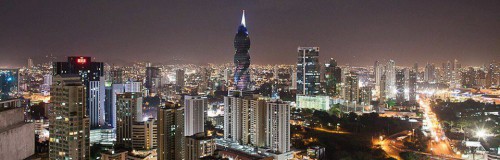
Chorrillo Nuevo: The transformation of a neighborhood
por Carlos Solis-Tejada
Imagine yourself 20 years from now taking a walk, biking, or maybe just near a sidewalk with a group of friends some weekend at a boardwalk located near the sea in a new residential area located in a small landfill made in front of Avenida de Los Poetas, in El Chorrillo and enjoying the beautiful sunset, the sea breeze and the beautiful sea-side view, eating a delicious fried fish, a ceviche, saus or a pixvae you just bought in some picturesque food stall and refreshing your thirst with an ice cold beer or fruit juice within an always loud, merry but clean 23rd Street.
Or maybe you are enjoying a gourmet dinner just nearby the marina/ which faces the fishermen’s cooperative harbor , just after enjoying a cultural morning which included museums and cultural centers or a shopping evening at the fish market or the farmer’s market which Chorrillo has available which you can reach from Amador just taking the tram coming from Amador on its way to Casco Viejo, but on its way making a stop near the small public local public transportation terminal where you can take either a cab, a bus or the tram. Maybe you will carry on, to San Felipe and luckily you might get a chance to listen to Los Campesinos of El Chorrillo playing some merry tropical rhythm in some of the numerous public green spaces framed within well structured blocks delineated by streets which lead to the sea with nice colorful apartments 5 stories high in Barraza (and not 18 as it used to be) facing the sea which this neighborhood has.
A neighborhood full of stories of love and solidarity but also of blood, terror and horror which the nice Chorrillo people can tell you about including the terrible U.S military Invasion and the destruction of more than half of the neighborhood in 1989, or the stories of knife killings or shootouts that tainted with blood for almost a quarter of a century this peaceful, merry and industrious neighborhood. Perhaps you may not be visiting, but enjoying all this from the comfort of your home in an apartment complex fully equipped with the basic utilities, and where your apartments is not simply just one room among a bunch, but one you can distinguish from the others with different sizes, colors and shapes that are in your building.
Your living space, thank God it is not at street level but on top of commercial or workshop facilities in your building’s floor ground.And in this same sunset watching your kids playing safely and healthily, you remember vividly how it used to be just when the sun hided and the night advanced your mother would rush and grab your arms and take you back to some of the downtrodden, stinking bleak and frightening Salomon type apartments, or going up very tired until the 13th floor of some of these huge apartment blocks in Barraza, or worst maybe in some shabby old barrack sorting some shootout among some of the local gangs. But let’s get back to 2005…
The present conditions are terrible, to begin with, El Chorrillo is a neighborhood that is disconnected from the rest of the city by a not very fluid and difficult way it communicates with the neighboring areas (Santa Ana, San Felipe, Amador and Balboa) either coming from the Pan-American Highway or coming from Santa Ana or trying to make your way out through Avenida Looking at Its road system within, things don’t look much better. If you are curious enough you can notice that it’s streets even though they seem to run to the seaside, they are in reality being interrupted from this connection by some building or sometimes the street itself bends or ends abruptly in the middle of nowhere.
El Chorrillo has suffered from wrong political practice which has abandoned socially the neighborhood and also form wrong housing policies typical of the 1960’s and 1970’s which imitated models coming from socialist Europe and its huge specialized residential neighborhoods, with no commercial, recreational or communual activities, and huge massive prefab apartments (an example of these you might see in Barraza’s apartment complex or in 24 de Diciembre apartments) It must be noticed that now days it is known that buildings destined for social housing must not be more than 5 stories high, surpassing this number would rise costs since they would need elevators and maintenance for these. Also they turn out into insecure and bleak due to the very little activity that might occurAfter the U.S military invasion a great part of the Chorrillo Neighborhood was destroyed en 1989.
But instead of taking of this situation, ( as regrettable as it might seem) to fix the neighborhoods deficiencies, the situation was worsened during the 1990´s first by relocating most of its original inhabitants intor far away areas and second placing in an unorderes and uncoordinated fashion “housing solutions” destined to the victims of big fires which took place in neighboring slums that even though they no longer are these huge housing buildings they follow the same trend that fills the area with housing with some or no reasonable commercial, working or recreational activities. The bottom line is their was no Master Plan, Urbanism was missing.
But all of this might change concretely if you wish, and believe it or not, there is people interested for this to happen. Since 2004, a team made up by the German architect and urbanist Michael Mussotter and his up to 30 students of Urban Design class at Texas Tech University in coordination with a small group of commited Panamanians coordinated by Carlos A. Solís-Tejada and Ernesto Hay, an architecture student, and Ernesto Hay, young Chorrillo community leader, all of them together have been working in holistic way and with social responsibility in “El Chorrillo Nuevo” a holistic urban renewal project that meanwhile has reached high plevels of professionalism and complexity.This project has the vision of a Chorrillo in which all of its streets have a direct virew to the sea, a Chorrillo where everone can live with dignity, a Chorrillo where you sons and your grandchildren don’t need to be under the threat of automobiles, gangs and drugs, Chorrillo where gangsters have no place and have no place to run away since there will not be badly illuminated areas, nor without proper neighbor watch thanks to easy visibility from the apartment blocks which will have a lot of people coming and going due to all the commercial an cultural activity that will be available., which makes a big deal of a difference if we compare it to the current situation in which social activity limited itself to reaching your living space and locking your apartment or perhaps if your were brave enough chat with your neighbors at the ground floor beside the streetA Chorrillo that will no longer be isolated from the rest of the city thanks to the improved road system and acces to the neighborhood so you will be able to go to Amador or San Felipe.
A Chorrillo where there will be a much better connection between the new blocks designed for the neighborhood.Chorrillo will be equipped with a more efficient local public transportation system, with a tram circuit and a small local bus and taxi terminal. A Chorrillo without big empty space with undefined uses, spreaded through the neighborhood such as the old bus terminal, empty spaces which are places infested with mosquitoes, trash, high grass, and hoodlums lurking also the neighborhood will have a better distribution of its buildings and population instead of densely populated areas such as Barraza with its high rises within a first phase in which thes will be replaced by replaced by more dignified apartments for its people. This will be achieved through blocks that will run from north to south, with well defined public, private and communal use spaces, that will be adequately populated but enough visual space and an optimum landscaping concept which at the same time offers spaces for cultural and recreational activities in the midst of the blocks by means of continuous public, private and communal green spaces. In one of the blocks, at the very core of El Chorrillo there will be a a multi-use park zone equipped with a community center, sports facilities and a swimming pool, the block are all bordered with 5 story apartments buildings with a floor ground commercial and communal space, these apartment buildings will fence the interior where there will be located other communal facilities, small housing solutions with 2 stories high within the block wihich gives them a sense of privacy and neighborhood in the midst of these blocks without creating gated communities.Another interesting part of this project is an institutional centre at the northeastern side with a public square, a church and a museum-documentation centre about the invasion and other communal facilities. Also there are plans for adding more land through a small landfill in front of Avenida de Los Poetas, and a big land fill at the bay between Amador and El Chorillo, where there is a proposal for a Marina together with a fishermen’s harbor which will be surrounded by big commercial areas that will extend north near the local bus terminal at the neighborhood’s west side near the Pan-American Highway where a new fish and farmers market and fried fish food stalls will be located which will turn this
Marina/Harbor into an important economic hub that will help to provide for direct and indirect employments for Chorrillo residents. The landfill project was developed in an intensive 4 day workshop with students form Texas Tech and Universidad de Panama’s, College of Architecture. Thse will be the most high valued land that will help attract investors to buy these land, if this is realized then the funds obtained from selling this landfill can be used to finance the rest of the neighborhood’s renewal.In the west side near the Pan-American Highway where there is presently a sports facility the local residents call “El Maracaná”, there are plns to create a small soccer stadium, a concert arena and a public park as a recreational and sports hub between Casco Viejo and Amador. Another interesting componente consistes of theconservation of buildings of great historical value for Panamanian Architecture such as the first samples of modernist Panamanian architecture exemplified in such buildings as Penonomé, Pesé and the rentas , besides these XX century buildings there are plans to conserve and renovate the buildings neighboring San Felipe and Santa Ana where there are some empty gaps which willed be filled in with buildings similar to the old ones. If this project becomes a reality it will become one of the first footsteps towards an unprecedented authentic urban renewal strategy for marginal areas of our cities. This project is feasible, but requires like any urban renwal prject an far sighted vision an that the residents contribute with their own hands, sweat and toil to improve their environment.Government, private sector and general public ’s help and interest is needed to move ahead with this project.
 La Ciudad Espléndida